

EMMC 2027 – 6th EMMC International Workshop
EMMC 2027, part of the biennial EMMC International Workshop series, will take place in Leuven, Belgium, from 20–22 April 2027.
The EMMC 2027 International Workshop brings together researchers, industrial innovators, software developers, data scientists, and policy experts to explore the theme “Materials Research in Transition.”
At a time when materials science is being reshaped by rapid advances in AI on data-driven workflows, modelling technologies, software development and industrial innovation, and digital infrastructures, the workshop provides a unique forum to discuss how Europe can build a strong, impactful and sustainable digital infrastructure for advanced materials.
The workshop will examine the profound transformation of materials research, from physics-based simulation to AI-enabled modelling, from fragmented datasets to connected materials knowledge, and from conventional workflows to increasingly autonomous discovery systems. Participants will explore practical, reliable, and sustainable pathways for industrial adoption of AI and modelling, while addressing the skills, software, and community solutions needed to thrive in a rapidly evolving research landscape.
Discussions will also focus on accelerating materials innovation from design to application, new materials innovation models for industry, and establishing robust governance frameworks that ensure the long-term sustainability of European digital research infrastructures.
Together, these conversations will help shape the next generation of digital materials research and innovation in Europe.
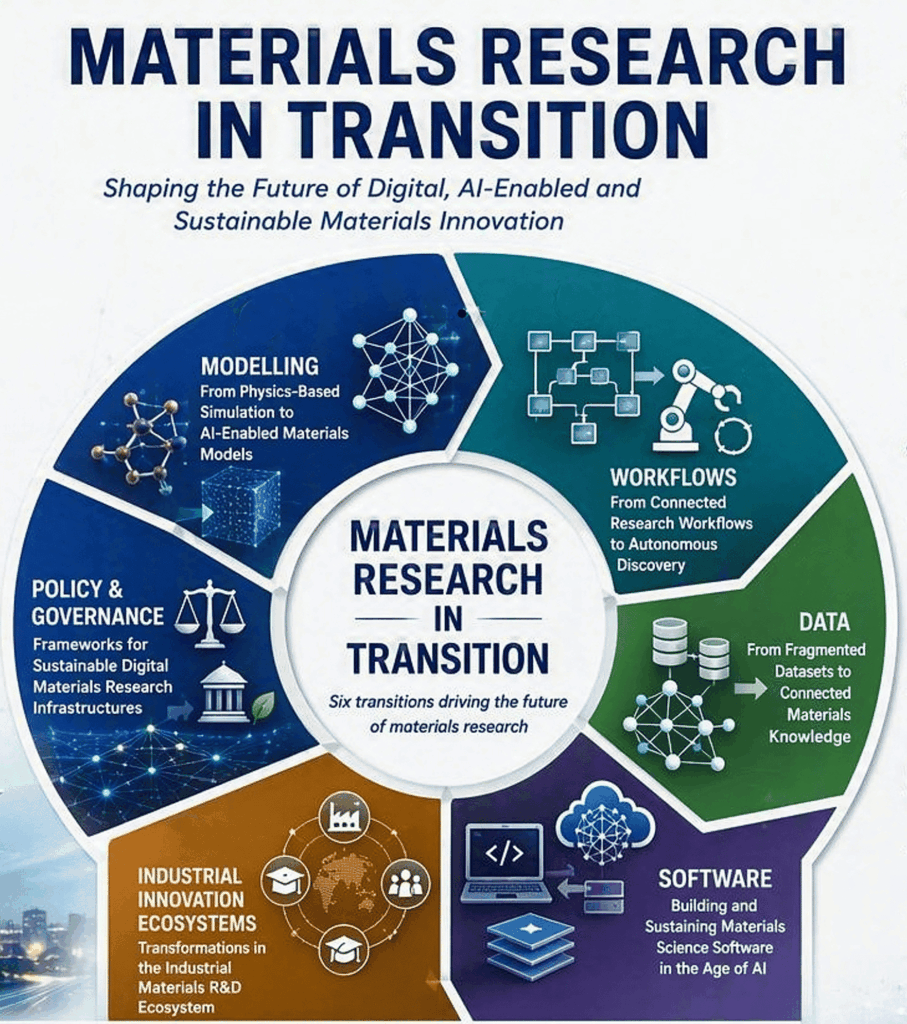
The 2027 theme, “Materials Research in Transition”, will be examined across six half‑day sessions, each addressing a major transformation shaping the field:
- Modelling – from physics‑based simulation to AI‑enabled materials models
- Workflows – from connected research workflows to autonomous discovery
- Data – from fragmented datasets to connected materials knowledge
- Software – building and sustaining materials science software in the age of AI
- Industrial Innovation Ecosystems – transformations in the industrial materials R&D ecosystem
- Policy & Governance – frameworks for sustainable digital materials research infrastructures
The workshop will offer keynotes, expert panels, interactive discussions, poster sessions and a hackathon.
The EMMC International Workshopis a leading, cross-cutting event where stakeholders from different materials & digital fields in industry and academia get together to discuss topics of strategic importance and elaborate on gaps and potential
Navigation
Programm
Registration & Welcome Coffee
Welcome by EMMC
SESSION 1
Modelling in transition: From Physics-Based Simulation to AI-Enabled Materials Models
Modelling in transition: From Physics-Based Simulation to AI-Enabled Materials Models
This session will explore how materials modelling is evolving through the integration of established physics-based approaches with machine learning, generative AI and emerging foundation models. Rather than replacing physical understanding, these methods can complement first-principles calculations, atomistic simulations and continuum modelling by accelerating predictions, linking different length and time scales, and identifying patterns in increasingly complex datasets.
The session aims to examine how hybrid physics–AI models can improve accuracy, efficiency, interpretability and generalisation, while reducing the amount of training data required. It will also address the potential of foundation models trained on diverse materials data to support multiple tasks, including property prediction, structure generation, simulation, inverse design and experimental planning.
Topics in scope of the session
- Physics-informed and physics-constrained machine learning
- Integration of AI with first-principles, atomistic and continuum models
- Materials foundation models and large scientific models
- Multiscale and multiphysics modelling
- Generative models and inverse materials design
- Uncertainty quantification, explainability and model validation
- Transferability across materials classes, scales and applications
- Data quality, benchmarking and reproducibility
- Computational infrastructure and access to advanced models
- The evolving role of theory, domain knowledge and human expertise
Description – Modelling in transition
Plenary
Coffee break
SESSION 1
Presentations & Discussion
Modelling in transition: From Physics-Based Simulation to AI-Enabled Materials Models
This session will explore how materials modelling is evolving through the integration of established physics-based approaches with machine learning, generative AI and emerging foundation models. Rather than replacing physical understanding, these methods can complement first-principles calculations, atomistic simulations and continuum modelling by accelerating predictions, linking different length and time scales, and identifying patterns in increasingly complex datasets.
The session aims to examine how hybrid physics–AI models can improve accuracy, efficiency, interpretability and generalisation, while reducing the amount of training data required. It will also address the potential of foundation models trained on diverse materials data to support multiple tasks, including property prediction, structure generation, simulation, inverse design and experimental planning.
Topics in scope of the session
- Physics-informed and physics-constrained machine learning
- Integration of AI with first-principles, atomistic and continuum models
- Materials foundation models and large scientific models
- Multiscale and multiphysics modelling
- Generative models and inverse materials design
- Uncertainty quantification, explainability and model validation
- Transferability across materials classes, scales and applications
- Data quality, benchmarking and reproducibility
- Computational infrastructure and access to advanced models
- The evolving role of theory, domain knowledge and human expertise
Description – Modelling in transition
Lunch
SESSION 2
Workflows in transition: from sequential research workflows to autonomous discovery
Workflows in transition: from sequential research workflows to autonomous discovery
This session will examine how materials-research workflows are evolving from largely sequential and discipline-specific processes into integrated, data-rich and increasingly autonomous systems. The focus will be on connecting modelling, synthesis, experimentation and characterisation within closed-loop workflows that can continuously learn, adapt and optimise.
Particular attention is given to the development of self-driving laboratories, where automated experimentation, real-time characterisation, machine learning and decision-making algorithms work together to accelerate materials discovery and process optimisation. The session also aims to address the practical challenges of integrating instruments, software, data standards and human expertise across different research environments.
Topics in scope of the session
- Integration of modelling, synthesis and characterisation
- Closed-loop and adaptive experimentation
- Automated and high-throughput laboratories
- Self-driving laboratories and autonomous decision-making
- Real-time and in situ characterisation
- Digital twins for experiments and processes
- Workflow orchestration and laboratory interoperability
- FAIR data, metadata and common data standards
- Robotics and intelligent instrumentation
- Reproducibility, validation and human oversight
- Scaling autonomous workflows from individual laboratories to shared facilities
Description – Workflows in transition
Plenary
SESSION 2
Presentations & Discussions
Workflows in transition: from sequential research workflows to autonomous discovery
This session will examine how materials-research workflows are evolving from largely sequential and discipline-specific processes into integrated, data-rich and increasingly autonomous systems. The focus will be on connecting modelling, synthesis, experimentation and characterisation within closed-loop workflows that can continuously learn, adapt and optimise.
Particular attention is given to the development of self-driving laboratories, where automated experimentation, real-time characterisation, machine learning and decision-making algorithms work together to accelerate materials discovery and process optimisation. The session also aims to address the practical challenges of integrating instruments, software, data standards and human expertise across different research environments.
Topics in scope of the session
- Integration of modelling, synthesis and characterisation
- Closed-loop and adaptive experimentation
- Automated and high-throughput laboratories
- Self-driving laboratories and autonomous decision-making
- Real-time and in situ characterisation
- Digital twins for experiments and processes
- Workflow orchestration and laboratory interoperability
- FAIR data, metadata and common data standards
- Robotics and intelligent instrumentation
- Reproducibility, validation and human oversight
- Scaling autonomous workflows from individual laboratories to shared facilities
Description – Workflows in transition
Poster presentations
Poster Session & Networking Event
Welcome by EMMC
SESSION 3
Materials industry in transition: Rethinking How Materials Are Developed, Scaled and Commercialised
Materials industry in transition: Rethinking How Materials Are Developed, Scaled and Commercialised
This session will examine how the industrial materials-innovation landscape is being reshaped by digitalisation, artificial intelligence, sustainability targets, supply-chain pressures and new models of collaboration. Materials companies are moving beyond traditional linear research and development towards more connected innovation ecosystems that integrate simulation, data, experimentation, manufacturing and life-cycle considerations.
The session explores how companies are adopting AI-enabled discovery, digital twins, advanced characterisation and automated workflows, while responding to demands for faster scale-up, lower environmental impact and greater resource resilience. It will also consider how roles are changing across industry, start-ups, universities, research infrastructures and technology providers, and what is needed to translate scientific advances into commercially viable materials and processes..
Topics in scope of the session
- AI- and data-enabled industrial materials research
- Digital twins and integrated product–process development
- Accelerating the transition from discovery to scale-up
- Pilot lines, demonstrators and advanced manufacturing
- Sustainable-by-design and circular materials innovation
- Critical raw materials and supply-chain resilience
- Industrial adoption of shared data standards and digital platforms
- Collaboration between industry, academia and research infrastructures
- Start-ups, venture investment and emerging business models
- Intellectual property, data ownership and knowledge sharing
- Regulation, certification and standards for new materials
- Workforce transformation and changing industrial skills
Description – Materials industry in transition
Plenary
SESSION 3
Presentations & Discussion
Materials industry in transition: Rethinking How Materials Are Developed, Scaled and Commercialised
This session will examine how the industrial materials-innovation landscape is being reshaped by digitalisation, artificial intelligence, sustainability targets, supply-chain pressures and new models of collaboration. Materials companies are moving beyond traditional linear research and development towards more connected innovation ecosystems that integrate simulation, data, experimentation, manufacturing and life-cycle considerations.
The session explores how companies are adopting AI-enabled discovery, digital twins, advanced characterisation and automated workflows, while responding to demands for faster scale-up, lower environmental impact and greater resource resilience. It will also consider how roles are changing across industry, start-ups, universities, research infrastructures and technology providers, and what is needed to translate scientific advances into commercially viable materials and processes..
Topics in scope of the session
- AI- and data-enabled industrial materials research
- Digital twins and integrated product–process development
- Accelerating the transition from discovery to scale-up
- Pilot lines, demonstrators and advanced manufacturing
- Sustainable-by-design and circular materials innovation
- Critical raw materials and supply-chain resilience
- Industrial adoption of shared data standards and digital platforms
- Collaboration between industry, academia and research infrastructures
- Start-ups, venture investment and emerging business models
- Intellectual property, data ownership and knowledge sharing
- Regulation, certification and standards for new materials
- Workforce transformation and changing industrial skills
Description – Materials industry in transition
Lunch
SESSION 4
Infrastructure in transition: Building sustainable digital materials infrastructures for research and industry
Infrastructure in transition: Building sustainable digital materials infrastructures for research and industry
This session will address how digital materials-research infrastructures can move from individual projects and fragmented platforms towards trusted, interoperable and sustainable services for the wider research and innovation community. It will combine European policy and implementation perspectives with practical experience from international materials-data and automation initiatives.
A central focus is the development of the European Materials Commons: a federated digital infrastructure intended to connect materials data, models, workflows and tools across research and industry. The European Commission’s advanced-materials agenda identifies the Materials Commons as a long-term digital infrastructure, while the Horizon Europe work programme calls for the demonstration of a pioneering federated infrastructure through practical use cases.
The session will look beyond initial technical development to consider what makes an infrastructure genuinely sustainable: stable funding, long-term institutional responsibility, community governance, interoperability, reliable software maintenance, skills, user support and environmentally responsible computing. Contributions from Japan, South Korea and Canada provide valuable comparisons between different national strategies, governance arrangements and models of service provision.
Topics in scope of the session
- European policy and roadmap for the Materials Commons
- From funded projects to persistent research services
- Federated architectures and interoperability between platforms
- Governance, ownership and institutional responsibility
- Sustainable funding and operational business models
- Long-term software, data and standards maintenance
- Connections with European research infrastructures, data spaces and EOSC
- Data sovereignty, cybersecurity and trusted access
- Balancing openness with intellectual property and industrial confidentiality
- Skills, user support and community engagement
- Environmental sustainability of data- and compute-intensive infrastructures
- International interoperability and reciprocal access
Description – Infrastructure in transition
Plenary
Panel
Panel including impulse talks from panelists & Discussion
Coffee break
Exhibition & Gold Sponsor Presentations
Poster Prize Award
Social event - Joint dinner
tba
Welcome by EMMC
SESSION 5
Data in transition: From Fragmented Datasets to Connected Materials Knowledge
Data in transition: From Fragmented Datasets to Connected Materials Knowledge
This session will explore the transition from fragmented, application-specific datasets towards connected and machine-actionable materials knowledge. It will focus on how linked data, ontologies, common vocabularies and semantic technologies can enable information to move more reliably across modelling, characterisation, synthesis and manufacturing workflows.
The session aims to examine how semantic interoperability allows data produced by different instruments, laboratories and computational tools to be interpreted and reused without losing scientific context. It will also address the role of FAIR data principles, persistent identifiers, provenance and knowledge graphs in supporting reproducibility, AI-ready datasets and collaboration across organisations and disciplines.
Topics in scope of the session
- Linked data and materials knowledge graphs
- Ontologies, taxonomies and controlled vocabularies
- Semantic interoperability across disciplines and platforms
- FAIR and machine-actionable data
- Metadata, provenance and persistent identifiers
- Connecting experimental and computational data
- Interoperability between instruments, repositories and research infrastructures
- Semantic annotation and automated data integration
- Data quality, validation and trust
- Standards and community governance
- Preparing materials data for AI and foundation models
- Intellectual property, access and data-sharing models
Description – Data in transition
Plenary
Session 5
Data in transition: From Fragmented Datasets to Connected Materials Knowledge
This session will explore the transition from fragmented, application-specific datasets towards connected and machine-actionable materials knowledge. It will focus on how linked data, ontologies, common vocabularies and semantic technologies can enable information to move more reliably across modelling, characterisation, synthesis and manufacturing workflows.
The session aims to examine how semantic interoperability allows data produced by different instruments, laboratories and computational tools to be interpreted and reused without losing scientific context. It will also address the role of FAIR data principles, persistent identifiers, provenance and knowledge graphs in supporting reproducibility, AI-ready datasets and collaboration across organisations and disciplines.
Topics in scope of the session
- Linked data and materials knowledge graphs
- Ontologies, taxonomies and controlled vocabularies
- Semantic interoperability across disciplines and platforms
- FAIR and machine-actionable data
- Metadata, provenance and persistent identifiers
- Connecting experimental and computational data
- Interoperability between instruments, repositories and research infrastructures
- Semantic annotation and automated data integration
- Data quality, validation and trust
- Standards and community governance
- Preparing materials data for AI and foundation models
- Intellectual property, access and data-sharing models
Description – Data in transition
Hackathon results demo
Lunch
SESSION 6
Software in transition: from AI-Assisted Software Engineering to Sustainable Research Software
Software in transition: from AI-Assisted Software Engineering to Sustainable Research Software
This session will examine how artificial intelligence is changing the way scientific software is designed, developed, tested and maintained. AI-assisted coding tools can accelerate implementation, documentation, debugging and user support, but they also introduce new questions concerning reliability, transparency, security, intellectual property and long-term maintainability.
The session aims to consider scientific software as critical research infrastructure rather than a temporary project output. Particular attention is given to the sustainability of community codes, the growing complexity of software ecosystems, and the skills and governance models needed to maintain trustworthy tools over time. It will discuss how AI may support software modernisation, interoperability and performance portability across rapidly evolving computing architectures..
Topics in scope of the session
- AI-assisted software development and code generation
- Automated testing, debugging and documentation
- Verification and validation of AI-generated code
- Scientific software sustainability and long-term maintenance
- Legacy-code modernisation and technical debt
- Reproducibility, provenance and software citation
- Open-source governance and community development models
- Software quality, security and supply-chain risks
- Interoperability, modularity and reusable software components
- Performance portability across CPUs, GPUs and emerging architectures
- Skills, career paths and recognition for research software engineers
- Licensing, authorship and intellectual-property implications
Description – Software in transition
Plenary
Session 6
Presentations & Discussion
Software in transition: from AI-Assisted Software Engineering to Sustainable Research Software
This session will examine how artificial intelligence is changing the way scientific software is designed, developed, tested and maintained. AI-assisted coding tools can accelerate implementation, documentation, debugging and user support, but they also introduce new questions concerning reliability, transparency, security, intellectual property and long-term maintainability.
The session aims to consider scientific software as critical research infrastructure rather than a temporary project output. Particular attention is given to the sustainability of community codes, the growing complexity of software ecosystems, and the skills and governance models needed to maintain trustworthy tools over time. It will discuss how AI may support software modernisation, interoperability and performance portability across rapidly evolving computing architectures..
Topics in scope of the session
- AI-assisted software development and code generation
- Automated testing, debugging and documentation
- Verification and validation of AI-generated code
- Scientific software sustainability and long-term maintenance
- Legacy-code modernisation and technical debt
- Reproducibility, provenance and software citation
- Open-source governance and community development models
- Software quality, security and supply-chain risks
- Interoperability, modularity and reusable software components
- Performance portability across CPUs, GPUs and emerging architectures
- Skills, career paths and recognition for research software engineers
- Licensing, authorship and intellectual-property implications